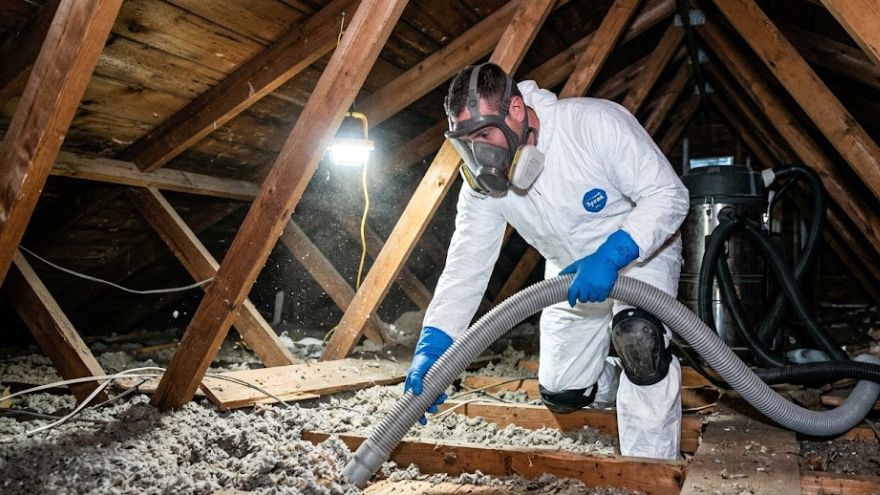
Rodent damage in a Lubbock home goes beyond the nuisance of an active infestation. An established roof-rat colony in an attic can produce four categories of structural and system damage over a single season: insulation compression and contamination, electrical wire chewing, HVAC duct and equipment interference, and structural wood gnawing. Understanding each category helps prioritize repairs and assess the true cost of a delayed treatment program.
Insulation damage.
Roof rats nest in attic insulation, and an established colony compresses insulation significantly. Blown-in cellulose or fiberglass insulation that should have a loft of 10–12 inches at R-38 can be compressed to 4–6 inches in heavily trafficked nesting areas, reducing R-value by 40–60% in those sections. The thermal performance loss translates directly to higher utility bills — the Lubbock summer HVAC load in an underinsulated attic is measurable.
Beyond compression, urine saturation makes insulation uncleanable in place. Rodent urine soaks into loose-fill insulation and doesn't disinfect from the surface down — the contamination runs through the material depth. When saturation is present, removal and replacement is more thorough than attempting to clean in place. See our insulation replacement service for the full protocol.
Electrical wiring damage.
Wire chewing is the most serious risk from attic rodent infestations in Lubbock homes, and it's the least visible from inside the living space. Roof rats gnaw on wire insulation as a continuous dental maintenance behavior. A chewed wire in an attic with exposed copper conductor can: arc against adjacent metal framing, ignite insulation material in contact with it, or cause circuit failures that present as flickering lights, tripped breakers, or intermittent circuit behavior.
The older homes in Tech Terrace, Overton, Heart of Lubbock, and Dunbar Manhattan Heights — where multi-season attic infestations are most common — also have the oldest wiring, which is more likely to have degraded insulation and fewer protective conduit runs. This combination makes an electrician inspection a reasonable precaution for any older Lubbock home that has had a confirmed roof-rat infestation.
HVAC damage.
Rodents interact with HVAC systems in Lubbock attics in several ways. Insulation compression near air handler equipment reduces the equipment's thermal environment. Nesting in or around air handler units creates debris that can contaminate the air stream. Gnawing on flexible duct sections or duct insulation can reduce airflow and allow conditioned air to escape into the attic. And a carcass in or near an HVAC return air intake is the worst-case scenario — decomposition odor circulated through the home's ductwork. We check HVAC equipment and accessible duct condition during attic inspections and flag any damage for HVAC contractor follow-up.
Structural wood gnawing.
Roof rats gnaw structural wood primarily to open or enlarge access gaps, not for food. Repeated gnawing at a specific structural location — a joist end, a rafter tail, a plate-to-stud junction — can reduce the cross-section of the member enough to be a structural concern in an older home where the lumber is already below modern span specifications. This is rare as a primary concern, but we note any significant structural gnawing found during inspections.
Repair priority framework.
| Damage type | Priority | Next step |
|---|---|---|
| Wire chewing (exposed copper) | Urgent | Electrician inspection before circuit use |
| Insulation saturation >20% of attic | High | Removal and replacement |
| HVAC duct gnawing | High | HVAC contractor inspection |
| Insulation compression, localized | Medium | Targeted removal + infill or full replacement |
| Structural gnawing | Medium to low | Carpenter assessment if member is load-bearing |