Roof rat removal in Lubbock, TX.
Roof rats are the dominant attic pest in Lubbock's older neighborhoods — Tech Terrace, Heart of Lubbock, Overton, Maxey Park — arriving fast when cold fronts hit and nesting in attic insulation through the winter. Attic inspection, targeted baiting, and roof-line exclusion are what actually stops them.
Call (806) 207-3665Roof rat removal is a species-specific program targeting Rattus rattus — the black rat, sometimes called the roof rat or ship rat — which nests in attics, dense vegetation, and elevated spaces rather than burrowing at ground level. In Lubbock, TX, roof rats are concentrated in older neighborhoods with mature tree canopy and older roof-line construction: Tech Terrace, Heart of Lubbock, Overton, Maxey Park, and Dunbar Manhattan Heights. They are most active from October through February, driven into attics by West Texas cold fronts.
Why roof rats are a Lubbock-specific problem.
The South Plains isn't typically thought of as prime roof-rat territory — the semi-arid climate and relatively sparse tree coverage in newer parts of the city keep populations lower there. But the older neighborhoods around Texas Tech, developed in the mid-20th century when larger trees were planted along the streets and in backyards, now have exactly the mature canopy that roof rats prefer. They move through trees, along power lines, and across fence tops before dropping to soffit vents and roof-line gaps to access attic spaces.
The timing is driven by West Texas weather. A cold front that drops temperatures 30°F in a single afternoon forces roof rats out of their tree-based nesting and toward warm interior spaces fast. The week of October 15 through November 15 is consistently our heaviest period for roof-rat attic calls. Homeowners who haven't addressed their soffit vents and fascia gaps over the summer call us after the first hard front because the rats have already moved in.
Roof rat activity in attics damages insulation, contaminates the attic space with droppings and urine, chews electrical wiring (a documented fire risk), and creates noise that's impossible to sleep through. Left unchecked through a Lubbock winter, a small roof-rat colony can cause thousands of dollars in insulation and wiring damage.
What this service includes.
- Attic inspection — full attic walk with headlamp and droppings mapping. Identifies active nesting areas, chewed wiring, runway paths, and all roof-line entry points.
- Roof-line inspection — soffit vents, gable vents, fascia-board gaps, chimney-base junctions, and any open pipe chases. All mapped before treatment begins.
- Attic baiting — tamper-resistant bait stations placed in the attic along confirmed runways, away from HVAC equipment and electrical panels.
- Roof-line exclusion — hardware cloth on soffit vents and gable vents; sheet metal or wood blocking at fascia gaps; foam-and-mesh at open pipe chases. Permanent materials only.
- Tree and vegetation assessment — flagging overhanging branches and dense shrubs that provide roof-rat access. Trimming recommendations where needed.
- Follow-up visit — 10–14 days post-treatment to confirm no new activity, recover carcasses, and close any secondary access points.
Our process — step by step.
Attic + roof-line inspection
Map every active nest site, runway, entry point, and instance of wire chewing before touching a bait station.
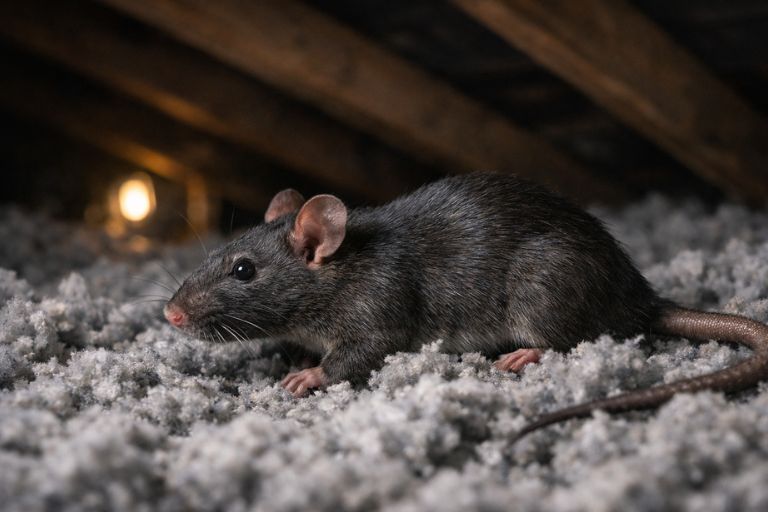
Attic bait deployment
Tamper-resistant stations on confirmed runways. Positioned away from HVAC equipment.
Roof-line exclusion
Hardware cloth on all vents. Sheet metal or blocking at fascia gaps. Foam-and-mesh at pipe chases.
Vegetation flag
Overhanging branches and dense shrubs flagged. Trimming access route recommendations provided.
Follow-up
Return at 10–14 days. No new droppings or nesting = program complete. Wiring damage flagged for electrician if found.
Pricing in Lubbock.
| Scenario | Typical range | Notes |
|---|---|---|
| Single-family — early-stage attic activity | $400–$650 | Inspection + baiting + vent exclusion |
| Established infestation — heavy attic nesting | $600–$900 | Extended baiting + full roof-line exclusion |
| Older home with multiple access points | $700–$1,100 | More entry points, more exclusion materials |
| Attic cleanup (add-on) | Quoted separately | Droppings removal + insulation assessment |
Inspections are free. Quotes confirmed before work starts.
DIY vs. professional.
| Factor | DIY | Professional |
|---|---|---|
| Attic access | Safety and orientation risk without experience | Standard on every roof-rat program |
| Roof-line gap identification | Fascia gaps and open pipe chases routinely missed | Checked from both attic interior and exterior |
| Vent exclusion materials | Plastic screening fails in months | Hardware cloth — permanent under Lubbock temperature range |
| Wire chew detection | Not visible from below without attic inspection | Flagged during attic walk — electrician referral provided |