Attic rodent proofing in Lubbock, TX.
Attic rodent proofing seals the roof-line access points that roof rats use every October — soffit vents, gable vents, and fascia gaps — with hardware cloth and sheet metal that holds through years of West Texas temperature cycling. It is the step that ends the annual attic infestation cycle.
Call (806) 207-3665Attic rodent proofing is the roof-line exclusion work that permanently closes the access points roof rats use to enter attic spaces — primarily soffit vents, gable vents, and the gaps where fascia boards meet roof sheathing as wood shrinks over time. In Lubbock, TX, attic proofing is the definitive long-term solution for the cold-front-driven roof-rat incursions that hit older neighborhoods every October.
How roof rats get into Lubbock attics.
Roof rats are exceptional climbers. They reach attic access points via trees, fences, utility lines, and brick wall surfaces. Once at roof level, the primary entry points are: soffit vents with deteriorated or missing screening, gable vents with plastic screening that has cracked or pulled away from the frame, and the junction between the fascia board and roof sheathing where wood has dried and shrunk over decades. Plastic or fiberglass screening on attic vents fails in West Texas conditions — UV exposure and temperature cycling cause it to crack at the corners within 3–5 years.
What attic rodent proofing includes.
- Roof-line inspection — physical inspection of every soffit vent, gable vent, fascia section, and roof-penetration point from both the attic interior and exterior.
- Soffit vent coverage — hardware cloth installed behind or inside every soffit vent opening. Existing deteriorated screening removed first.
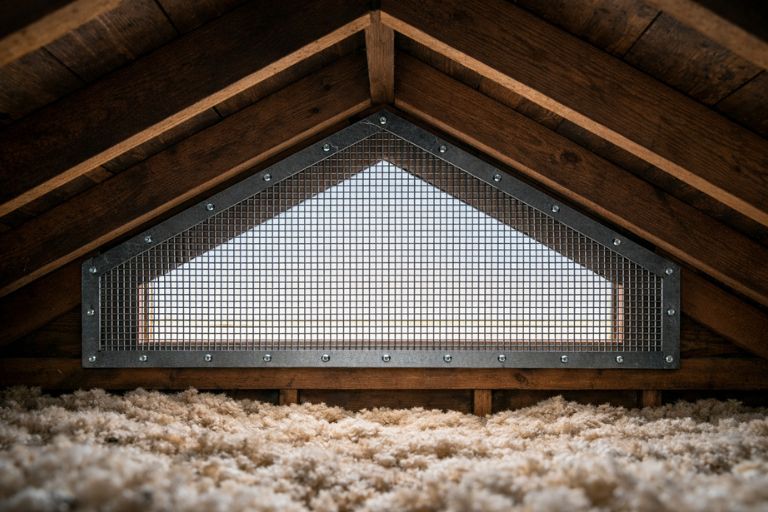
- Gable vent reinforcement — hardware cloth applied to every gable vent opening, fastened to the frame.
- Fascia-gap blocking — sheet metal or wood blocking plus mesh at the fascia-sheathing junction where gaps exist.
- Pipe chase sealing — foam-and-mesh at every roof penetration where the boot or flashing does not fully close the circumference gap.
- Documentation — before-and-after photo record of every sealed location.
Our process.
Roof-line inspection
Attic interior and exterior — every vent, every fascia section, every roof penetration mapped before sealing.
Soffit vent coverage
Hardware cloth installed behind every soffit vent. Deteriorated existing screening removed first.
Gable vent reinforcement
Hardware cloth applied to every gable vent opening, fastened to the vent frame.
Fascia-gap blocking
Sheet metal or wood blocking at fascia-sheathing gaps. Mesh over any remaining opening.
Pipe chase sealing
Foam-and-mesh at roof penetrations. Flashing gaps closed.
Pricing in Lubbock.
| Scenario | Typical range | Notes |
|---|---|---|
| Soffit + gable vent coverage only | $300–$550 | Standard vent exclusion — most Lubbock homes |
| Full attic proofing (vents + fascia + pipe chases) | $500–$900 | Complete roof-line treatment |
| Attic proofing after treatment (add-on) | $250–$600 | When combined with roof-rat removal program |
| Large or two-story home | $700–$1,200 | More linear feet of roof line to address |
Inspections are free. Quotes confirmed before work starts.