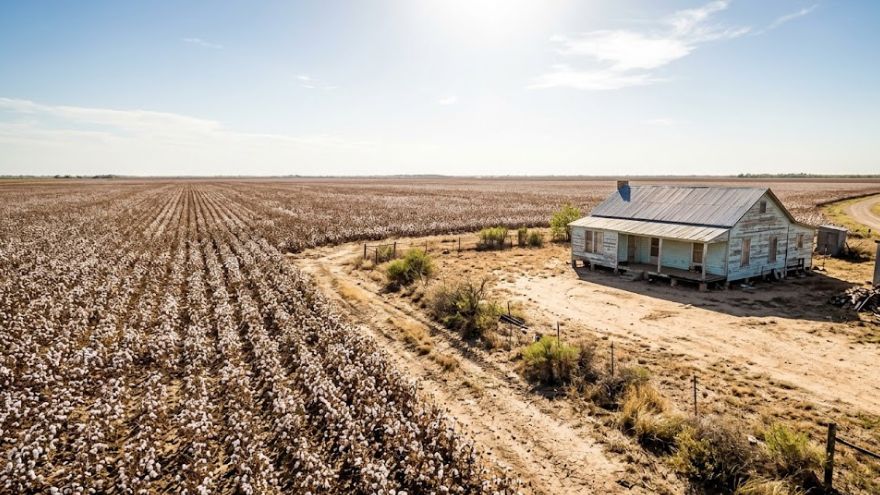
Lubbock County's agricultural character creates a rodent pressure dimension that doesn't exist in more purely urban markets. Properties near active farmland — whether residential subdivisions built into former cotton fields, oilfield operations near agricultural land, or the rural properties that haven't been developed — experience rodent pressure from a much larger reservoir than urban properties face. This guide covers why agricultural-edge pressure is different and what it means for control approaches.
The agricultural rodent reservoir.
Active farmland sustains large field rodent populations through the growing season. Cotton, sorghum, and grain fields provide both food (from the crop itself and from post-harvest residue) and shelter (in crop canopy during the growing season, in straw and residue after harvest). These field populations are primarily field mice (Mus musculus and Peromyscus species), but Norway rat populations near grain storage and feed operations can be large and persistent.
The reservoir population adjacent to a developing subdivision or rural property is orders of magnitude larger than the urban rodent population near a central Lubbock neighborhood. A 100-acre cotton field on the edge of Wolfforth can sustain several thousand field mice. When cold weather or harvest disruption pushes that population toward residential construction at the field edge, the infestation pressure is substantially higher than anything a mid-city Lubbock neighborhood faces.
Harvest-season displacement.
Cotton and grain harvest in October and November — which coincides with the cold-front season for roof-rat pressure — creates additional displacement pressure. Harvest machines disturb the field population; residue management removes shelter; and the disruption pushes large numbers of field mice toward the nearest alternative shelter, which is residential construction at the field edge. The intersection of cold-front season, harvest season, and agricultural-edge location produces the highest rodent pressure events we see anywhere in our service area.
What agricultural-edge programs look like differently.
Standard residential exclusion remains the foundation — weep holes, door sweeps, utility penetrations. But the exterior bait station program matters more at agricultural-edge properties than in urban locations, because the ongoing pressure from the field reservoir means that even a well-sealed home needs a perimeter interception program to prevent population buildup at the foundation before animals find the remaining entry points. Monthly exterior station service is the right rotation frequency for properties within 500 feet of active farmland; bi-monthly service works for properties farther from the field edge.
Which Lubbock-area communities have the highest agricultural-edge pressure.
Wolfforth and Shallowater have seen significant residential development into former agricultural land and have some of the highest agricultural-edge pressure of any community in our service area. Newer subdivisions in the southern and eastern development corridors of Lubbock proper have similar dynamics. The rural towns — Abernathy, Floydada, Tahoka, Levelland — are surrounded by farmland and experience harvest-season pressure city-wide rather than just at the perimeter.
See our agricultural rodent control program for farm and ranch property programs, and our Wolfforth and Shallowater area pages for the specific pressure profiles in those communities.