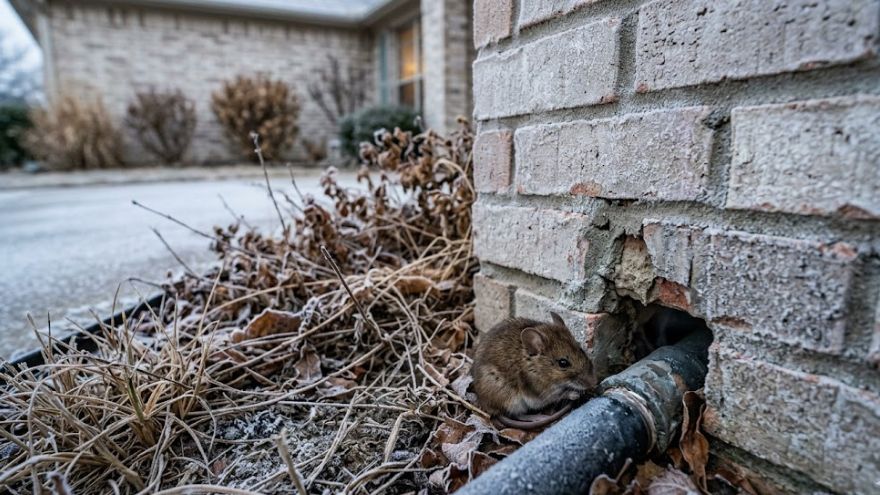
If you live in Tech Terrace, Overton, or any of Lubbock's older tree-canopy neighborhoods, you may have noticed a pattern: the first significant cold front of fall is followed within 24–48 hours by the sound of something in the attic. This isn't coincidence. The relationship between West Texas cold-front meteorology and roof-rat attic intrusion behavior is direct and well-documented in the calls we take every year. Understanding the mechanism helps explain both why the problem is so consistent and how to prepare for it.
How West Texas cold fronts work.
A typical South Plains cold front is a dry line or arctic air mass that sweeps across the Llano Estacado from the northwest. Unlike cold fronts in more humid climates that arrive gradually, West Texas cold fronts can drop temperatures 20–30°F in a matter of hours — sometimes within a single afternoon. The rapid onset is what matters for roof-rat behavior. A temperature change that takes two weeks in a coastal climate takes hours in Lubbock. Roof rats don't have the behavioral adaptation time that a slower temperature decline would allow.
What rapid cold stress does to roof-rat behavior.
Roof rats are warm-weather adapted animals. Their preferred ambient temperature is above 65°F, and they begin to experience thermal stress well below 50°F. When a cold front drops Lubbock temperatures from the mid-70s to the mid-30s in an afternoon, roof rats in tree canopy and exterior vegetation experience acute thermal stress simultaneously across a large urban area. Their response is immediate: probe every possible warm enclosure within reach. In the older Lubbock neighborhoods where they're established, the reach is often directly to a roofline gap or soffit vent that connects to an attic space that sits at 60–70°F even when it's 35°F outside.
The critical factor is that this probing behavior is intense and persistent. A roof rat that is thermally stressed will try the same access point repeatedly over hours. A soffit vent gap that a rat casually explored in September and decided against may be entered decisively in October when the temperature has dropped and the alternative is continued cold exposure in a tree.
The 48-hour window after a cold front.
Our call volume data is consistent: attic activity calls spike in the 24–48 hours after a significant cold front, not before it. The front pushes animals to entry points, and homeowners notice the activity at night when they're in bed and the attic is active above them. The animals that entered during the front's initial passage begin establishing nesting behavior within 12–24 hours of entry, which is why the sounds change character from exploratory (moving around, testing the space) to more consistent and patterned (running established routes) within the first few days.
Which properties are at highest risk after a cold front.
Properties that combine three factors are at the highest risk during any given cold-front event: mature trees with branches that overhang or touch the roofline (the access route from canopy to roof), older construction with degraded soffit vent screening or open fascia gaps (the entry point), and no prior professional exclusion work (the open door). In Tech Terrace, Overton, and Maxey Park — the three highest-pressure neighborhoods in Lubbock for attic roof-rat calls — a majority of properties meet at least two of these three criteria, which is why these neighborhoods generate the most post-cold-front calls.
How to prepare before a front arrives.
The preparation window for Lubbock homeowners who want to prevent cold-front-driven attic intrusions is August through mid-October — before the first significant fronts of the year. A professional inspection during this window identifies the open access points; exclusion sealing during this window closes them before the pressure event. For homeowners in older neighborhoods with mature trees, this pre-season exclusion investment is more cost-effective than treating an established attic colony after intrusion. See our attic proofing service for the full roof-line exclusion program.
Emergency response: If you hear attic activity the night after a cold front and haven't had exclusion done, call us at (806) 207-3665. Same-day inspection is available. Acting in the first 48–72 hours after an intrusion event, before the animals establish fixed nesting sites, significantly reduces the scope of the required program.