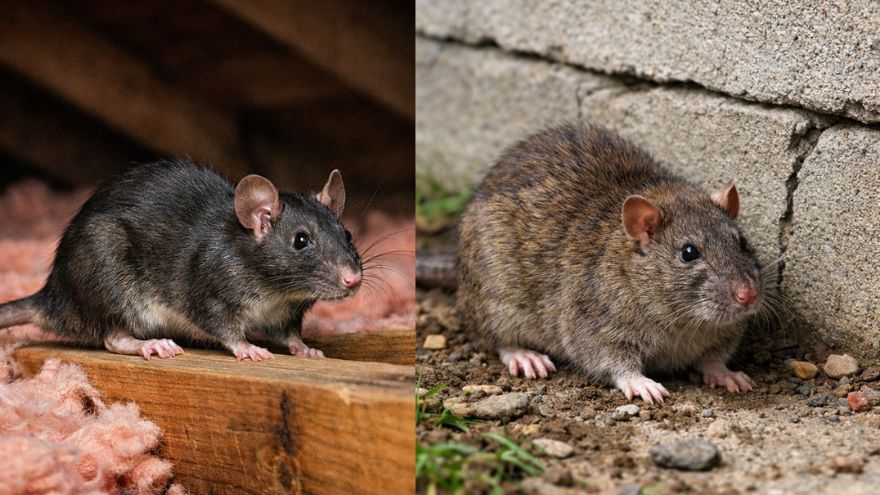
Rat control in Lubbock, TX means working with two distinct species that behave differently, nest in different places, and require different treatment approaches. Roof rats (Rattus rattus) and Norway rats (Rattus norvegicus) are both established in Lubbock County, but confusing one for the other leads to treatment programs that fail. This guide covers how to identify each species from the evidence they leave, and what the correct control approach is for each.
The two rat species in Lubbock, TX.
Lubbock sits at the edge of multiple ecological zones that support both species. Roof rats arrived in Texas through the port cities and spread inland along tree canopy corridors. They're now well-established in Lubbock's older neighborhoods with mature trees — Tech Terrace, Overton, Heart of Lubbock, Maxey Park, and Dunbar Manhattan Heights are consistently our highest-call neighborhoods for roof-rat attic work. Norway rats followed a different route: they're native to Asia and arrived in North America through shipping, spreading across the country along river corridors and human development. In Lubbock, they're concentrated in the downtown commercial zone, agricultural operations, and anywhere food waste and sewer infrastructure are concentrated.
Identification by body and behavior.
| Feature | Roof Rat | Norway Rat |
|---|---|---|
| Body length | 6–8 inches | 7–10 inches |
| Weight | 5–9 oz | 7–18 oz |
| Nose | Pointed | Blunt |
| Ears | Large, nearly hairless | Small, thicker |
| Tail | Longer than body | Shorter than body |
| Color | Black to dark gray | Brown to gray |
| Behavior | Climber, arboreal | Burrower, ground-level |
| Nesting level | Attic, tree canopy, upper walls | Under slabs, burrow systems, lower walls |
In practice, most homeowners never see the rat itself. The identification usually comes from the indirect evidence — droppings, runway location, and nesting height.
Identifying by droppings.
Droppings are the most reliable field indicator when you can't see the animal. Roof rat droppings are 1/2 to 3/4 inch long, spindle-shaped with pointed ends, and found primarily in elevated locations — along attic beams, on top of wall plates, near nesting material in insulation. Norway rat droppings are larger, 3/4 inch or longer, capsule-shaped with blunt ends, and found at ground level — along foundation walls, near dumpsters, under equipment, in burrow entrances.
One important caveat: droppings from house mice are often mistaken for roof rat droppings by homeowners doing their own assessment. Mouse droppings are 1/8 to 1/4 inch, pointed at both ends, and much smaller. If you're finding what appears to be very small rat droppings in wall voids and kitchen cabinets, it's almost certainly mice, not rats.
Identifying by runway location.
Roof rats are arboreal by instinct. Their runways are elevated — along fence tops, power lines, tree branches, and the tops of wall studs in attics. Grease rub marks from roof rats appear on attic beams and on the surface of insulation where they repeatedly travel. Norway rats run at ground level. Their grease marks appear on the base of walls, along foundation perimeters, and near burrow entrances. If you're finding grease runs near the floor, it's almost certainly Norway rats or mice. Runs on elevated structural members are almost certainly roof rats.
Lubbock-specific pressure by season.
Roof rat pressure in Lubbock spikes sharply in the October through February window, driven by West Texas cold fronts that push animals out of trees and toward attic access points. The neighborhoods with the most consistent roof-rat calls — Tech Terrace, Overton, and Maxey Park — all have dense mature canopy and older construction with degraded soffit vents and fascia gaps. Norway rat pressure in Lubbock is year-round, concentrated in the downtown commercial corridor and at agricultural edge properties. It doesn't follow the same cold-front pattern because Norway rats aren't arboreal — they're already in ground-level burrows and aren't displaced by temperature changes.
Control methods by species.
The treatment approach differs significantly between species. For roof rats: attic inspection first (physical entry, droppings mapping, nesting location, entry-point ID), followed by attic bait stations on confirmed runways, and roof-line exclusion sealing — hardware cloth on soffit vents, blocking at fascia gaps, mesh at pipe chases. The exclusion step is what prevents recurrence; without it, the same access points bring in a new population the following cold season.
For Norway rats: ground-level inspection — foundation perimeter, burrow mapping, dumpster-area assessment, sewer-access investigation — followed by burrow treatment, exterior bait stations on perimeter runways, and foundation-level exclusion sealing at pipe penetrations and drain-cover gaps. The sewer-access assessment is particularly important in older downtown Lubbock properties, where cast-iron sewer lines with deteriorated joints can provide direct entry from the sewer system.
Key takeaway: Treating a roof-rat problem with a ground-level Norway rat program, or vice versa, produces poor results. Species ID from droppings, runway height, and nesting location before treatment starts is not optional — it determines everything that follows.
When you have both species.
Multi-species infestations are more common than most homeowners expect, particularly in older Lubbock neighborhoods close to downtown. Roof rats in the attic and mice in the kitchen wall is the most common combination we find. Less frequently, we find roof rats in the attic and Norway rats at the foundation level simultaneously. In these cases, the treatment has to address both levels — there's no single program that covers both species with one set of bait stations. See our full guide to combined rodent removal for how we approach multi-species properties.