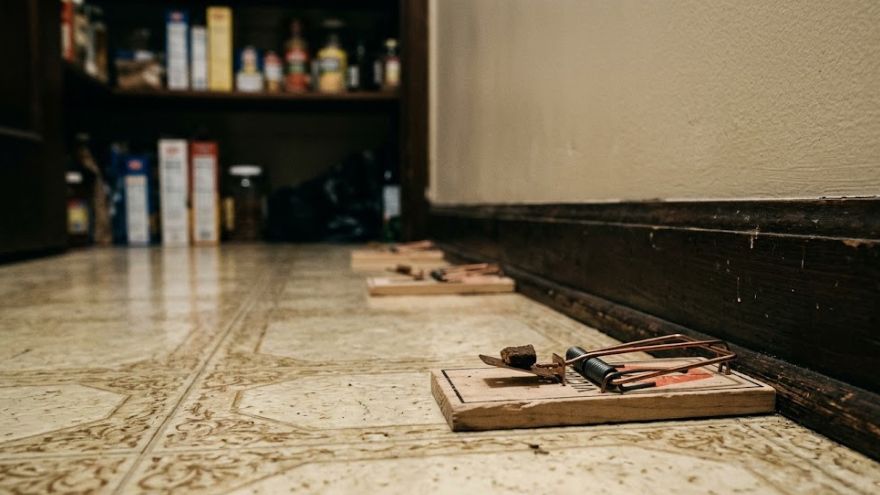
Most of the rodent calls we take are second-opinion calls — homeowners who tried to handle the problem themselves for several weeks before calling us. The DIY attempts we most commonly see aren't wrong because people chose poorly; they're wrong because the commonly available information on rodent control doesn't account for Lubbock's specific construction profile and rodent species mix. These are the mistakes we see most consistently, and what should happen instead.
Mistake 1: Treating without identifying the species.
The most fundamental error in DIY rat control is starting treatment before confirming which species you have. A roof-rat program requires attic access and roof-line exclusion. A Norway rat program requires ground-level burrow treatment and foundation exclusion. Applying a ground-level bait station program to a roof-rat attic infestation produces poor results because the animals aren't at ground level. Applying attic trapping to a Norway rat burrow situation misses the population entirely. Before doing anything, identify which species you have from droppings, runway location, and nesting level. See our identification guide.
Mistake 2: Sealing the entry point before treating the interior.
This is the most consequential DIY mistake and the one that generates the most difficult follow-up calls. A homeowner finds a gap at the exterior and seals it — either with foam, caulk, or hardware cloth — before treating the animals that are already inside. The animals already inside are now trapped. Within 3–7 days, the trapped animals die in the wall or attic space, and the resulting odor can be severe. The correct sequence is always: treat first, verify the population is eliminated at follow-up, then seal the entry points.
Mistake 3: Wrong trap placement.
Snap traps placed in the wrong location will not catch anything, regardless of bait. Mice and rats run along wall edges and fixed routes — they don't cross open floor space to investigate a trap placed in the center of a room. Snap traps should be placed flush against the wall with the trigger end facing the wall surface, positioned along the confirmed runway (where droppings and grease marks indicate repeated traffic). For attic traps, they should be placed on attic beams or rafters — roof rats don't run across the insulation surface, they run on structural members. A correctly placed snap trap is triggered by an animal that runs along its normal route; an incorrectly placed trap waits indefinitely.
Mistake 4: Using foam or steel wool for exterior exclusion.
These are the two most commonly recommended DIY exclusion materials, and both fail at exterior locations in Lubbock's climate within a season. Foam expands, contracts, and cracks under West Texas temperature cycling. It can also be chewed through by rats. Steel wool rusts and compresses under moisture exposure — after one wet season, it's no longer blocking the gap effectively. The correct materials for permanent exterior exclusion are copper mesh (for weep holes and smaller gaps), hardware cloth (for vents and larger gaps), and sheet metal or concrete patch (for structural gaps). These are the materials that hold under Lubbock conditions for years rather than months.
Mistake 5: Not doing a follow-up droppings inspection.
This is how homeowners convince themselves a DIY program worked when it didn't. If traps were deployed and the sounds stopped, the assumption is that the problem is resolved. But sounds stopping can mean the remaining population is small enough that its activity isn't audible anymore — not that the colony is gone. A droppings inspection 10–14 days after treatment starts is the only reliable way to confirm the colony is eliminated. Fresh droppings in a previously active area (darker, pliable) mean the colony is still active. Absence of new droppings in the same area after 10–14 days means it's resolved. Without this step, a partially resolved infestation is easily missed.
Mistake 6: Skipping the exclusion entirely.
Treating without excluding produces a temporary result. The entry points that allowed the current population in are still open for the next population. In Lubbock's cold-front cycle, a home treated in November without exclusion is at high risk of reinfestation in the following October when the pressure builds again. The exclusion step is what breaks the annual cycle, and it's the step most DIY programs skip because it's the most labor-intensive.
If you've tried DIY and it hasn't worked: The most likely explanation is one of the above — wrong species identification, trapped animals, wrong trap placement, failing exclusion materials, or no follow-up verification. Call (806) 207-3665 for a free second-opinion inspection. We can usually tell within the first inspection visit what the DIY program missed.