Understanding where rats enter a Lubbock home is the foundation of an effective exclusion program. Entry points for roof rats and Norway rats are distinct — they access structures at different elevations and through different gap types. This guide covers every common entry point we find during inspections in Lubbock residential construction, organized by location and species.
Roof-line entry points (roof rats).
Soffit vents.
The most consistent roof-rat entry point in Lubbock. Soffit vents are designed with screening to allow attic airflow while blocking pests, but the plastic and fiberglass screening used in most residential construction degrades in West Texas UV and temperature conditions within 3–5 years. We find cracked, missing, or pulled-away vent screening on a majority of Lubbock homes we inspect. Fix: Hardware cloth (1/4-inch galvanized mesh) installed behind or inside the vent frame. Not replacement plastic screening — that will fail again.
Fascia-sheathing gap.
The junction between the fascia board (the vertical board at the roof edge) and the roof sheathing (the plywood or OSB surface the shingles are attached to) develops a gap as the fascia wood dries and shrinks over time. On homes older than 20–30 years, this gap is often 1/2 inch or larger — enough for a roof rat to compress through. It's not visible from the ground; you need to look up from a ladder or from the attic interior to see it. Fix: Sheet metal blocking or wood blocking with mesh, fastened to both the fascia and sheathing surfaces.
Gable vents.
Triangular or rectangular vents at the gable ends of the attic are a less common entry point than soffit vents but are found open in older construction. Same degraded-screening issue as soffit vents, with the same hardware cloth fix.
Pipe and conduit penetrations at the roof.
Water heater flue pipes, dryer vent boots, plumbing vent pipes, and electrical conduit penetrations through the roof surface each have a potential gap around the circumference where the pipe or conduit exits through the roofing material. In older installations, the original boot or flashing may have pulled away from the pipe surface, creating a gap. Fix: Foam backer rod fill plus sealant for smaller gaps; hardware cloth backing before sealing for larger gaps.
Foundation-level entry points (mice and Norway rats).
Weep holes.
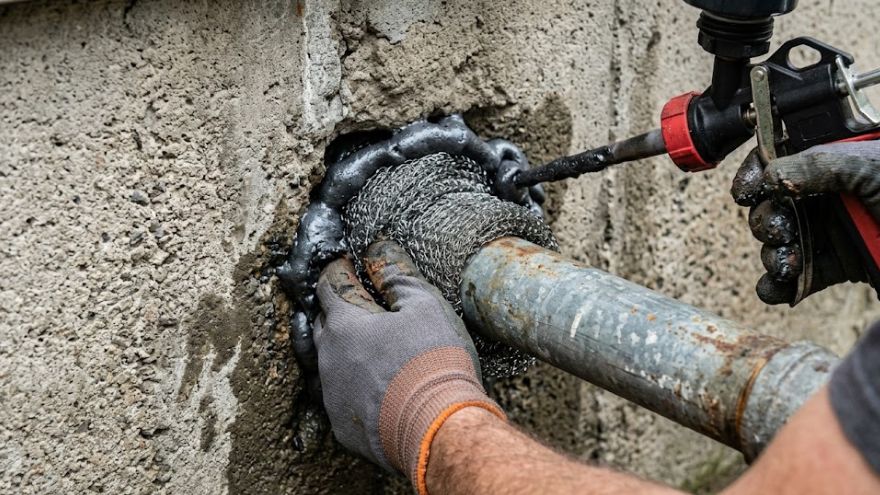
The single most underestimated entry point in Lubbock residential construction. Brick-veneer homes have weep holes — small drainage gaps in the mortar line at the base of the brick — spaced every 24–32 inches around the full perimeter. They're 3/4 inch wide and open directly into the wall cavity. Every standard Lubbock brick home has 40–80 of them. Most homeowners have never heard of them. Most pest programs don't address them. Fix: Copper mesh pressed into every weep hole. Copper specifically — not steel wool, not foam.
Utility pipe penetrations.
Every water supply line, drain pipe, gas line, and electrical conduit that exits through the exterior wall has a potential gap around it. These gaps are typically sealed with caulk at installation, but caulk fails at exterior locations under Lubbock temperature cycling. Check every penetration by feel — if you can fit a pencil into the gap, a mouse can too. Fix: Foam backer rod for fill, exterior-grade sealant over it. For gaps over 1/4 inch, add copper mesh fill before the sealant.
Garage door bottom seal.
The garage door bottom seal is one of the most consistently worn entry points in Lubbock homes. A seal that doesn't contact the floor completely along its full width creates a gap that mice can enter. Worn rubber compresses and cracks over time. Fix: Replace the full-width seal. Close the door and check for light along the entire bottom — if light is visible anywhere, a mouse can get through.
Foundation cracks.
Hairline cracks in the foundation or foundation stucco widen over time and can reach mouse-entry width. Norway rats can exploit foundation-level gaps that are large enough for their head, and their gnawing can widen smaller gaps over time. Fix: Concrete patch for hairline cracks; concrete patch with hardware cloth insert for larger gaps near the grade line.
Norway rat-specific: drain covers and sewer access.
Norway rats in older downtown Lubbock and near sewer-adjacent infrastructure exploit drain cover gaps and deteriorated sewer line joints to access buildings from below. Floor drains with missing or cracked covers, and any drain-cover gap at the foundation perimeter, are potential Norway rat access points. Fix: Replace missing drain covers; seal gaps at foundation-level drain cover perimeters with concrete patch and mesh.
See our exclusion service for professional inspection and sealing of all of the above. Free inspection, before-and-after photo documentation, permanent materials.