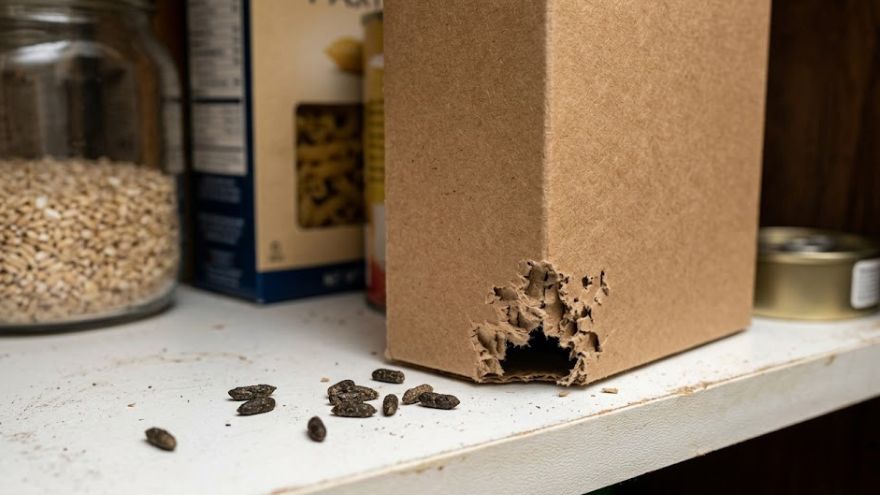
A house mouse infestation in Lubbock, TX doesn't announce itself — it builds quietly behind walls, under appliances, and in wall voids for weeks or months before most homeowners notice. By the time activity is obvious, the colony is established. This guide covers every sign of mouse activity that Lubbock homeowners should know, what each sign tells you about the size and location of the infestation, and when the evidence indicates a professional program is the right next step rather than hardware-store traps.
Droppings — the most reliable early indicator.
Mouse droppings are the first sign most Lubbock homeowners find. House mouse droppings are 1/8 to 1/4 inch long, pointed at both ends (often described as rice-grain shaped), and dark brown to black when fresh. They lighten to a dusty gray as they age. The location of droppings tells you more than the presence alone: droppings inside kitchen base cabinets or under the sink indicate the colony is already in the kitchen wall or toe-kick space. Droppings in the back corners of pantry shelves mean the food supply is being accessed. Droppings along the base of walls in a bedroom or utility closet indicate a travel route — the mouse is moving from its nesting site to a food or water source through that space.
The volume of droppings is a rough proxy for colony size. Isolated droppings in one area suggest a single animal or a small number of animals exploring for food. A dense concentration in multiple locations — under the refrigerator, in two cabinet corners, and along the baseboard near the stove — indicates an established colony with multiple individuals using multiple food and water sources.
What to do: Don't sweep or vacuum droppings dry — this aerosolizes hantavirus particles. Wet the area first with a disinfectant spray, wait five minutes, then remove with a damp cloth and gloves. See our droppings cleanup guide for the full safe protocol.
Scratching sounds — and what they mean by location.
Scratching, rustling, and light scurrying sounds in the walls or ceiling are one of the most common reasons Lubbock homeowners call us. The location and timing of the sounds provide diagnostic information. Sounds coming from inside walls near the kitchen, concentrated at night, suggest mice in the kitchen wall void. Sounds in the ceiling in the center of the home at night are less likely to be mice and more likely to be roof rats; mouse activity in ceilings is less common because mice prefer to run along wall bases and stay close to food sources. Sounds in the garage, particularly near the base of the walls, suggest mice entering through the garage and setting up near the food sources (pet food, birdseed, stored goods) that garages often contain.
Timing matters. House mice are primarily nocturnal — sounds at night are far more common than daytime sounds. Daylight scratching activity indicates the population is large enough that competition for nighttime foraging space is pushing animals into daytime activity, which is a sign the infestation is established and requires professional treatment rather than a DIY trap deployment.
Gnaw marks — what's being chewed and why it matters.
Mice gnaw continuously to wear down their continuously growing incisors. Fresh gnaw marks are pale wood or plastic; older marks darken as they oxidize. On food packaging, gnaw marks indicate the colony has established a reliable food source and is accessing it repeatedly. On structural wood — baseboards, cabinet bases, wall sheathing — gnaw marks indicate the colony is expanding its travel route or enlarging a gap for easier access. On electrical wiring, gnaw marks are a fire risk that requires an electrician assessment regardless of whether the pest problem is resolved.
In Lubbock homes, the most common locations we find gnaw marks are: cabinet toe-kicks (where mice chew to enlarge the gap under the cabinet base), baseboards in pantry corners (where a tight turn is gnawed open for easier passage), and around pipe penetrations under the sink (where mice are enlarging an existing gap). These gnaw marks indicate the specific travel routes the colony is using, which is critical information for trap placement.
Grease rub marks.
Mice have oily fur that leaves a dark grease smear wherever they repeatedly travel along the same surface. In Lubbock homes, the most common locations are: the base of walls where mice run (a dark smear line along the baseboard 1–2 inches above the floor), around pipe penetrations under the sink, and at the base of exterior weep holes where mice repeatedly enter. Grease marks take weeks to develop — their presence indicates the infestation has been active for a significant period, not a recent intrusion.
Odor.
A large mouse colony produces a distinctive musky ammonia odor from urine accumulation. This is most noticeable in enclosed spaces: behind the stove, inside kitchen cabinets, in the utility closet, or in the garage corner where the colony is nesting. If you can smell it without opening anything, the population is substantial. If you smell it only when opening a cabinet, the colony may be smaller but is actively using that space.
Nesting material.
Mouse nests are small, roughly fist-sized structures made from shredded material: insulation fibers, paper, fabric scraps, pet hair, and plant matter. They're found in dark, undisturbed locations: inside wall voids (typically discovered only during renovation work), behind large appliances, inside insulation in crawl spaces, and in undisturbed storage areas in garages. Finding a nest with fresh material — still pliable, not dried out — indicates active use. A nest with dried material and old droppings may be from a previous infestation.
How Lubbock construction creates specific warning sign patterns.
Lubbock's brick-veneer housing stock has a specific entry pattern for house mice: through weep holes at the base of the brick into the wall cavity, then across the wall base into the kitchen space. This means the most productive places to look for early signs in a Lubbock brick home are: the exterior weep holes (check for fresh gnaw marks or copper mesh already installed), the interior base of kitchen cabinets, and the space under the sink near the pipe penetration. If you're finding droppings in all three of these locations, the colony has established the entry-point-to-food-source route and is active. A professional program is warranted — not because the problem can't be addressed, but because the colony is large enough that single-trap placement won't resolve it. See mouse infestation treatment for the multi-visit approach.
When to call a professional: Droppings in more than one room, audible activity in more than one wall section, any daylight mouse sighting, or gnaw marks on electrical wiring. These indicators mean the colony is established and a DIY program is likely to reduce but not eliminate it.