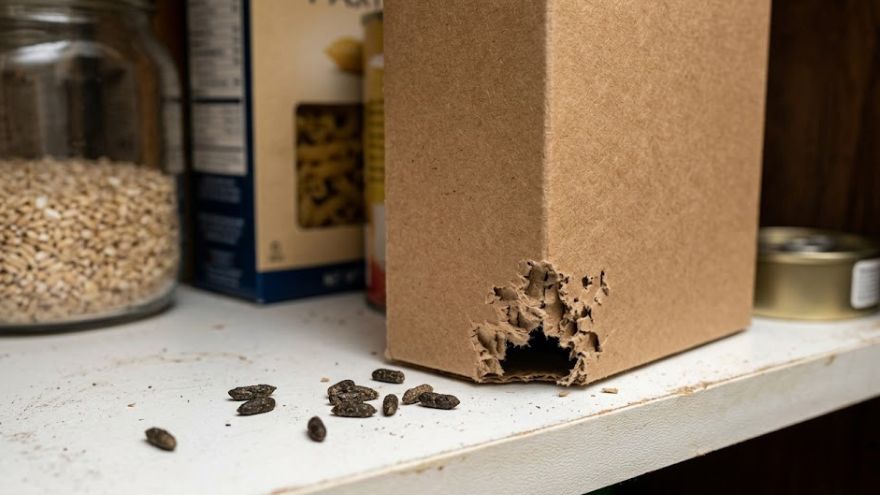
House mice don't wander into Lubbock homes randomly — they follow specific attractants that make a given property more appealing than the surrounding environment. Understanding what draws mice in is useful both for prevention and for understanding why a previous treatment program didn't hold: if the attractants aren't addressed alongside the trapping and exclusion, the property will continue to attract new animals to replace the ones that were removed. This guide covers the three categories of attractants — food, water, and shelter — with the specific sources in Lubbock homes that matter most.
Food attractants in Lubbock kitchens.
House mice in Lubbock are generalist feeders — they'll eat almost anything humans eat, plus pet food, birdseed, and many stored goods. But the specific food sources that matter most for attractant control are the ones mice can access easily, repeatedly, and without much effort. In Lubbock kitchens, the most consistent attractants are: dry goods stored in cardboard or paper packaging (cereal, rice, pasta, pet food, birdseed), crumbs and food debris under appliances, and open trash cans that aren't sealed at night.
The practical counter-measures are specific: transfer dry goods from cardboard packaging into sealed hard plastic or glass containers (not just sealing the box opening, but removing the cardboard entirely), keep the area under appliances swept, and use a trash can with a lid that closes completely. These steps reduce the food source, but they don't eliminate the attractant entirely — even a clean kitchen has crumbs. Exclusion sealing is more reliable than food management alone for stopping mouse entry.
Water sources mice use in Lubbock homes.
House mice can survive on remarkably little water — less than a teaspoon per day, and they can extract much of that from food itself. But they do seek water when it's available, and certain water sources in Lubbock homes are consistent attractants. The most common are: condensation on water supply pipes (particularly in the utility area and crawl space), the small water accumulation that occurs under the drain trap under the kitchen sink, pet water dishes left out overnight, and any minor plumbing leak. None of these need to be large sources — even a dripping pipe in the crawl space or a slow drain leak provides enough water for a mouse colony.
Shelter attractants in Lubbock construction.
This is where Lubbock's specific construction profile creates unique attractant conditions. Brick-veneer homes have weep holes — the small drainage gaps at the base of the brick that open directly into the wall cavity. The wall cavity is warm in winter, dark, undisturbed, and directly adjacent to the kitchen. For a house mouse outside in a West Texas cold front, a Lubbock brick home is an obvious destination. The weep hole to kitchen wall route is the most consistent attractant/entry-point combination we address in Lubbock — it's the reason we seal weep holes with copper mesh on every mouse program we run in this city.
Beyond weep holes, the other significant shelter attractants are: the garage (warm, dark, contains food sources, and typically has the least-tight-sealed door sweeps and base gaps of any entrance to the home), the water heater closet (continuous heat source), and the space behind large appliances. These aren't entry points, but they're the first places inside the home that mice establish as permanent habitat once they've entered.
Outdoor attractants that increase pressure on Lubbock homes.
What's happening outside the home before mice get in is as relevant as what's inside. The most significant outdoor attractants in Lubbock are: bird feeders (birdseed is extremely attractive to mice and positions the food source near the exterior of the home), firewood stacked against the exterior wall (provides nesting material and shelter adjacent to the building), dense ground-cover vegetation along the foundation, and pet food left outside. Each of these creates a mouse population pressure point close to the home that increases the probability of a mouse finding and exploiting an entry point.
What the cold-front pressure pattern means for attractant management.
Lubbock's cold fronts don't just push roof rats into attics — they also create temporary cold stress in house mice that dramatically increases their motivation to seek indoor shelter. A mouse that has been living in a burrow in the yard or in the dense ground cover along the foundation perimeter will test every possible interior access point when a cold front drops the temperature 25°F in a few hours. This means the attractant management steps above matter most in the October through March window. Sealing the entry points before the first cold front is more effective than trying to manage the pressure after mice are already inside.
Bottom line: Attractant reduction makes a property less appealing, but exclusion sealing makes it inaccessible. For lasting protection from Lubbock's annual mouse pressure, exclusion is the more reliable investment. See our mouse proofing service for the full protocol.